
Updated: 2026-06-01
Quick answer: Co-parenting communication works when it is short, factual, and strictly about the child. Pick one channel, lead with the request instead of the grievance, use “I” statements rather than accusations, and give yourself a beat before answering anything designed to provoke you. Children’s adjustment after a separation tracks the conflict they witness, so disciplined communication is not just about keeping the peace between adults — it directly protects the child.
Disclaimer: This article is for general information only and is not legal, medical, or psychological advice. Custody and family law vary by state and country. For decisions affecting your children or your case, consult a licensed family attorney and, where appropriate, a qualified mental health professional.
Most co-parenting advice tells you to “communicate better,” which is useless when you are mid-conflict and every message feels like a trap. What actually helps is a small set of concrete habits that take the emotion out of the exchange and keep it on the only thing you both still share: the child.
The parents who communicate well after a split are rarely the ones who get along. They are the ones who treat the relationship like a working partnership — clear, documented, and unbothered by bait. This guide covers the habits that hold up under stress.
Table of Contents
- What makes co-parenting communication work?
- How do you keep messages low-conflict?
- Which tools keep communication organized?
- How do you communicate with a high-conflict co-parent?
- How do you handle the hardest conversations?
- Frequently Asked Questions
What makes co-parenting communication work?
Good co-parenting communication rests on three habits: clarity, real listening, and managing your own emotions. Each one lowers the odds that a routine exchange turns into an old argument.

Clarity and consistency. Use plain language and stick to facts about the schedule, health, or school. When both parents send the same message and follow the same routines, children feel more secure and there are fewer mixed signals to argue about.
Active listening. Hearing the other parent — not just waiting to reply — defuses a surprising amount of conflict. Summarizing what you heard before you respond (“So pickup moves to 5, got it”) signals cooperation and catches misunderstandings early.
Emotional regulation. The American Psychological Association ties children’s post-separation adjustment to the conflict they witness, which makes controlling your own reaction a parenting skill, not just self-care. When a message lands wrong, pause before answering — the reply you don’t fire off in anger is usually the right one.
How do you keep messages low-conflict?
You keep messages low-conflict by making them brief, neutral, and focused on the next step rather than the last grievance. A useful test: would this message read fine if a judge saw it? If not, rewrite it before sending.

A handful of techniques carry most of the load:
| Technique | What it does | In practice |
|---|---|---|
| “I” statements | Removes blame, lowers defensiveness | “I need the schedule by Sunday to plan” — not “You never tell me the plan” |
| Business-like tone | Keeps it factual and court-safe | State the request and stop; no defending or relitigating |
| One channel | Creates a record, limits chaos | Route all non-emergencies through the app or email |
| Fixed reply window | Ends the constant-disruption cycle | Answer routine messages within 24 hours, not instantly |
| Pause before sending | Stops escalation | Wait a beat before replying to anything meant to provoke |
The single highest-value swap is leading with the question or fact instead of the complaint. “When will pickup be?” gets an answer; “Why are you always changing plans?” starts a fight. Keep messages short and specific, describe what you observed rather than what you assume the other parent meant, and write down any agreement you reach so you are not relitigating it next month. These habits sit on top of the boundaries every co-parent should set and feed directly into reducing overall conflict.
Which tools keep communication organized?
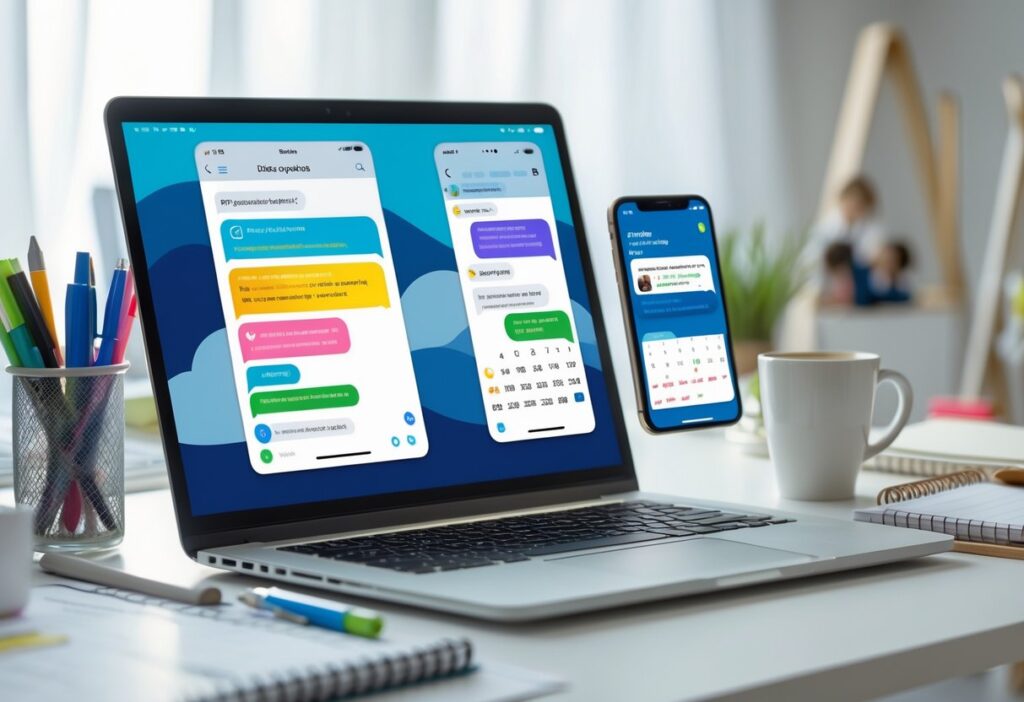
The right tools turn scattered, emotional back-and-forth into an organized, documented record. A shared calendar and a co-parenting app handle most of what otherwise becomes a fight about who said what.

A shared calendar lets both parents see and update the schedule, appointments, and school events in one place, which removes the “I didn’t know” excuse and the resentment behind it. Agree on how you will use it — who adds events, how far ahead changes go in, whether notifications are on.
Co-parenting apps add structured messaging, expense tracking, and a permanent log of communication. That record matters most in tense situations, because it keeps exchanges neutral and gives you documentation if a dispute ever reaches court. Pick one that both parents will actually use — simple enough for the less tech-comfortable parent, with the features you need (reminders, expense splitting, document sharing). The tool will not fix an emotional conflict on its own, but it removes the logistical friction that emotional conflict hides behind.
How do you communicate with a high-conflict co-parent?
With a high-conflict or manipulative co-parent, the goal shifts from cooperation to containment: keep contact minimal, written, and impossible to use against you. You cannot control their behavior, only your exposure to it.
The core moves: keep every message about the child only, decline to engage with insults or bait, and document everything. The BIFF approach — brief, informative, friendly, firm — keeps a reply civil without giving the other parent material to escalate. When direct communication keeps blowing up, parallel parenting shrinks contact to logistics-only and lets each parent run their own household with minimal overlap. For patterns specific to a manipulative co-parent, see how to co-parent with a manipulative ex.
When you cannot resolve recurring disputes on your own, a neutral mediator can help without going to court — the Association of Family and Conciliation Courts (AFCC) sets practice standards for these professionals. If messages ever cross into threats or you feel unsafe, save everything and talk to a family law attorney; persistent harassment can be relevant to custody.
How do you handle the hardest conversations?
Handle hard conversations — money, discipline, a clashing parenting style — by preparing for them, keeping them child-focused, and giving yourself an exit when they overheat.

A few practical moves make these talks survivable. Set a short agenda so the conversation does not sprawl into old grievances. Choose a neutral time and place, not a charged handoff. Use “I” statements to raise concerns without an accusation, and if things heat up, name it and take a break — “Let’s pick this up tomorrow” beats saying something you will regret.
Differences in parenting style are their own challenge. You do not need identical homes; you need enough overlap on the basics — bedtime, screens, discipline — that the child is not whiplashed between two sets of rules. Where you genuinely cannot agree, write the agreed basics into the parenting plan and let mediation settle the rest. Parenting classes and support groups can add tools and remind you that the situation is common, not a personal failure.
Frequently Asked Questions
What are the best ways to set boundaries in co-parenting communication?
Agree on clear rules for schedules, decision-making, and how you communicate, and respect each other’s time and space. A shared calendar for appointments and visits adds structure, and a co-parenting app keeps messages documented and on-topic. Stick to the plans you set, and when something changes, tell the other parent as early as possible.
How do you communicate with a high-conflict co-parent?
Keep messages short, factual, and focused on the child, and use “I” statements like “I need the schedule so I can plan.” Don’t react to provocation — write instead of calling so you have time to think and a record of what was said. Neutral language and getting straight to the point lower the temperature.
What strategies work for co-parenting with a narcissistic ex-partner?
Keep communication about the child only and stay out of emotional arguments and manipulative exchanges. Set firm written boundaries, document every interaction, and limit contact to logistics. When the pattern continues, a mediator or counselor — and sometimes a parallel-parenting structure — protects both you and the child.
How do you create a co-parenting plan that minimizes misunderstandings?
A good plan spells out the schedule, decision-making roles, and what to do in emergencies, so each parent knows their responsibilities. Agree on how you will communicate and resolve disagreements, and review the plan periodically — it has to change as the child grows and circumstances shift.
What tools help co-parents communicate better?
Co-parenting apps such as OurFamilyWizard, TalkingParents, and Cozi offer shared calendars, structured messaging, and expense tracking. They organize communication, reduce crossed wires, and keep a record of what was said — useful for staying coordinated even when the two parents are not on speaking terms.
How can parents get past common communication blocks?
Start by noticing your own emotional triggers, and pause a conversation that is heating up instead of pushing through it. Listen closely and ask open-ended questions to find the real issue. When both parents keep the child’s needs at the center, it is far easier to cooperate and avoid finger-pointing.







5 thoughts on “Co-Parenting Communication: Strategies That Actually Work”