Updated: 2026-06-01
Quick answer: Help children adjust to two homes by making both feel predictable and theirs: keep core routines (sleep, meals, homework) similar across homes, give the child a space and duplicate essentials in each, keep a shared calendar they can see, and keep conflict away from handoffs. Most children settle within a day of each switch when the adults stay calm and consistent. What unsettles kids is rarely the two homes — it is unpredictability and witnessing conflict between their parents.
Disclaimer: This article is for general information only and is not legal, medical, or psychological advice. Custody and family law vary by state and country. For decisions affecting your children or your case, consult a licensed family attorney and, where appropriate, a qualified mental health professional.
Living out of two homes asks a lot of a child: two sets of rooms, two sets of rules, and a regular goodbye to one parent to go be with the other. The shuffle is real, and it is normal for kids to find it hard at first.
But the difficulty is mostly manageable with structure. When both homes feel predictable and the child feels they belong in each, the back-and-forth stops being a rupture and becomes just the rhythm of their life. This guide covers how to build that.
Table of Contents
- Why is living between two homes hard for kids?
- How do routines reduce the stress?
- How do you give kids a sense of belonging in each home?
- How do you support them emotionally?
- How do you make transitions smoother?
- Frequently Asked Questions
Why is living between two homes hard for kids?
Living between two homes is hard because it stacks several changes at once — a lost single home, divided time with each parent, and different routines in each place — on top of the emotions of the separation itself. Naming what a child is carrying helps you respond to it.
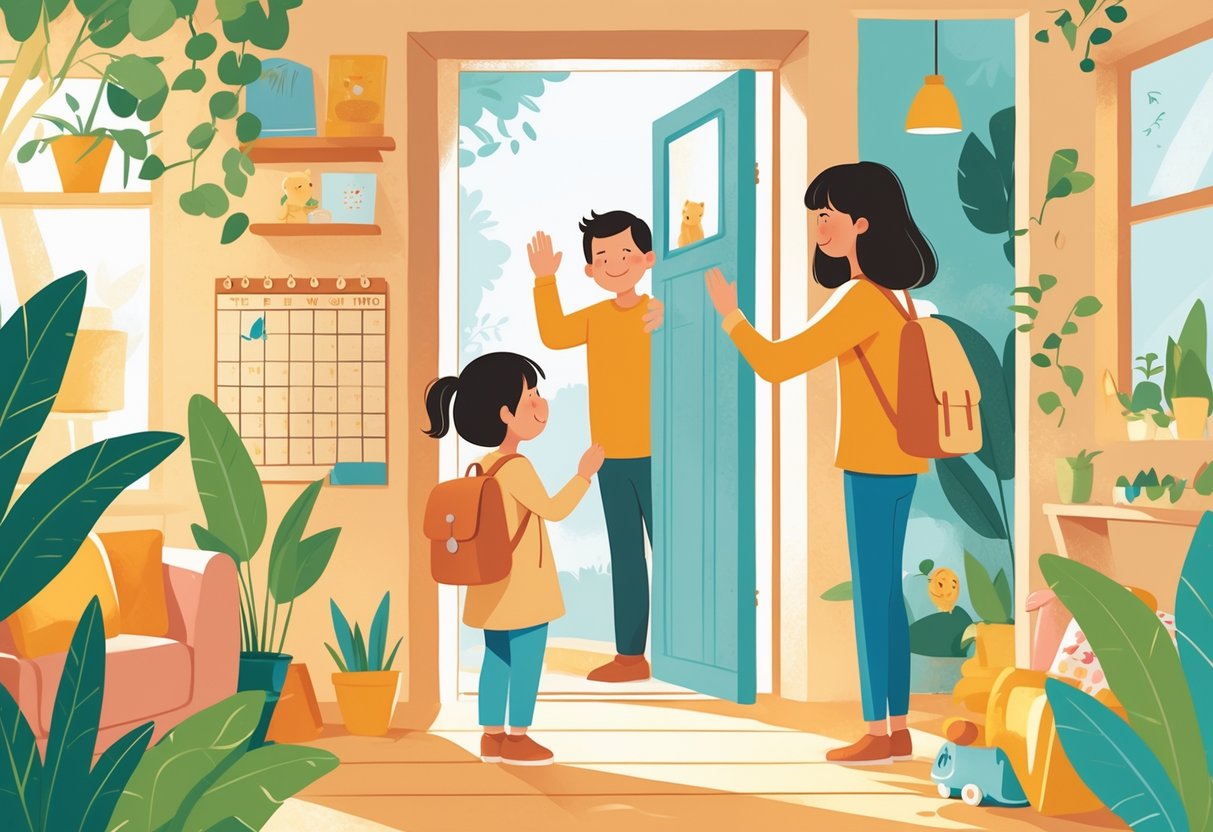
Common reactions are sadness, anger, confusion, and a sense of being torn between parents. Some children act out around transition days; others go quiet or anxious. The American Psychological Association finds that children’s adjustment depends far more on the conflict they witness than on the living arrangement, so the two homes are rarely the real problem — the tension around them is.
Watch for signs a child is not coping: sudden aggression or withdrawal, sleep trouble or frequent headaches, a drop in grades, or open fear about switching homes. If these persist beyond a few weeks, a child counselor can help. Our guide on the signs a child is struggling with co-parenting covers what to look for in more detail.
How do routines reduce the stress?
Routines reduce stress because predictability is what makes a child feel safe — when they know what comes next, the change between homes loses its threat. Consistency across the two homes is the single biggest stabilizer you have.
Aim to match the anchors of the day — wake-up, meals, homework, and bedtime — even if the homes differ in style. You do not need identical houses; you need enough overlap that the child is not whiplashed at each switch. Agree on the basics of behavior too: screen time, chores, and house rules that are roughly consistent so the child is not testing two different sets of limits.
Coordinate the practical load as well. Share information about homework, projects, and events, and divide rides to activities so nothing slips through the cracks. A shared calendar the child can see removes surprises about where they will be and when they will next see the other parent. The American Academy of Pediatrics’ guidance on family dynamics reinforces how much routine matters to a child’s sense of security.
How do you give kids a sense of belonging in each home?
Children settle faster when each home feels like theirs, not like a place they are visiting. A sense of belonging comes from having their own space and familiar things in both places.
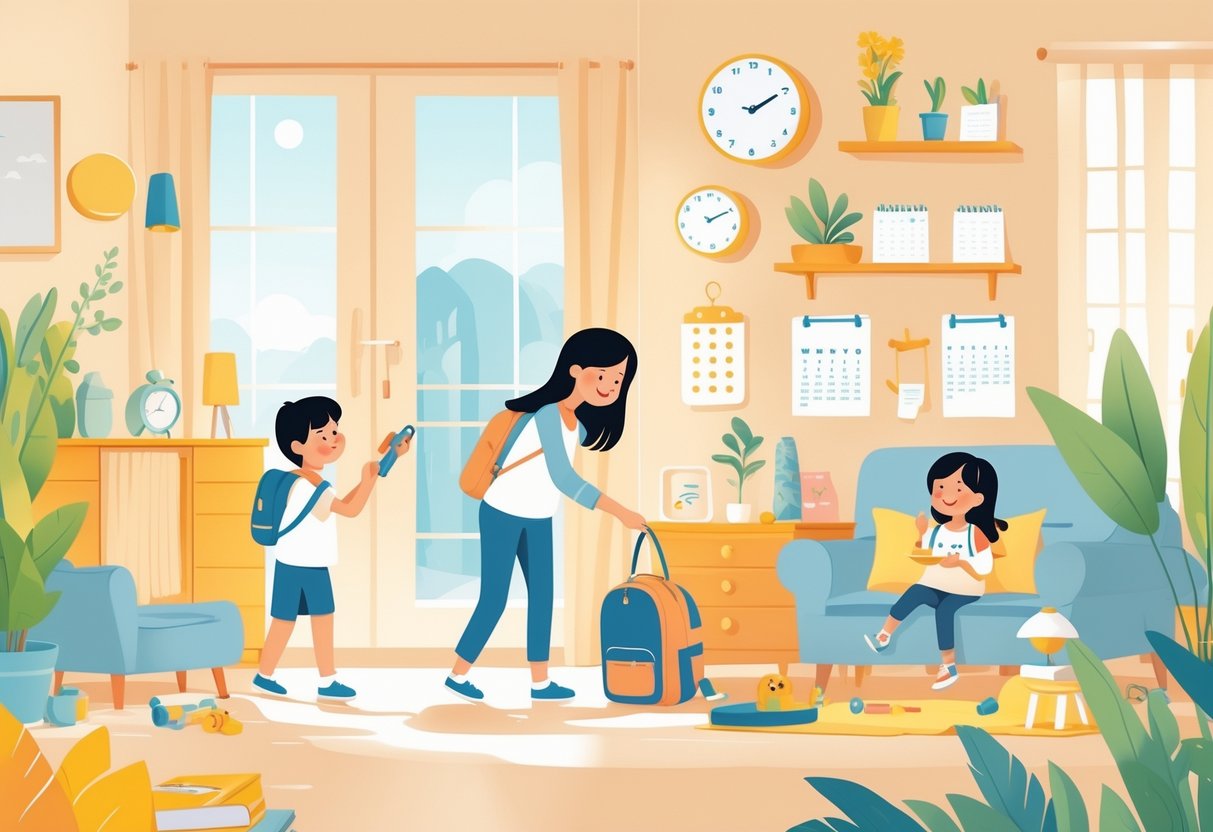
A few practical moves make the biggest difference:
| What helps | Why it works |
|---|---|
| Matching core routines (sleep, meals, homework) | Predictability lowers a child’s anxiety |
| Duplicate essentials in both homes | No packing stress or forgotten items |
| A space that’s the child’s own | Builds belonging rather than feeling like a guest |
| The same comfort object in both homes | An emotional anchor that travels across the switch |
| One shared calendar the child can see | Removes surprise about where they’ll be next |
| Low conflict at handoffs | The transition feels safe instead of scary |
Give the child a dedicated spot in each home — a bedroom or even a cozy nook — and let them personalize it with photos, books, or their own bedding. Keep duplicates of everyday essentials (toothbrush, pajamas, chargers, school supplies) at both places so a transition never hinges on remembering to pack. And keep the same comfort item — a favorite blanket or stuffed animal — in both homes when you can; for younger children especially, that familiar object is a powerful anchor.
How do you support them emotionally?
Support children emotionally by making it safe and normal to talk about how the two-home life feels — and by responding to worries with empathy instead of solutions. Children adjust better when their feelings are heard, not managed away.

Invite feelings out with open questions — “How do you feel about going to Dad’s tomorrow?” — and accept the answer without rushing to fix it. Saying “It’s okay to feel sad or mixed up about this” does more than any reassurance that everything is fine. Younger children who cannot find the words often do better with drawing or a journal. Make these check-ins regular, not just crisis-driven, so sharing becomes ordinary.
Let the child stay connected to the other parent during their time away — a quick call or text, within reasonable limits, helps them feel secure without undermining the current home. When a child raises a worry, respond with curiosity (“What part is hardest?”) rather than dismissal, and never let the conversation slide into blaming the other parent. The American Academy of Pediatrics’ resources on children’s emotional wellness and the CDC’s child-development guidance are useful references for what is developmentally normal.
How do you make transitions smoother?
Make transitions smoother with predictable rituals and calm, brief handoffs — the moments of the switch itself are where a child’s anxiety peaks or settles. Small, repeated habits do most of the work.

Build a consistent transition ritual: the same meeting spot, a familiar phrase, maybe a quick hug or a small snack for the road. Repetition signals normalcy and tells the child what to expect. Keep the handoff short and cordial even if you and the other parent are not close — no arguments or negative comments in front of the child, neutral tone, on time. The logistics of a clean exchange are covered in tips for a smooth child custody exchange, and managing your own nerves in the moment in how to stay calm during custody handoffs. If the separation is recent, talking to your kids about the divorce in an age-appropriate way sets the foundation for everything here.
Frequently Asked Questions
What helps children transition between their parents’ homes?
Visual aids like a shared calendar help children know when they’ll be at each home and when they’ll see the other parent. Keep a positive, calm attitude at transitions and avoid conflict in front of the child. Consistent routines build security, and letting the child call or text the other parent can make the time apart feel shorter.
How do you reduce the impact of a 50/50 schedule on kids?
Set up similar routines in both homes — not identical, but consistent enough to feel predictable — and keep communication between parents open so the child senses the adults are aligned. Watch how your child responds to transitions and stay flexible; small schedule adjustments often relieve pressure for everyone.
How can parents support a child after divorce?
Create emotional safety by speaking positively, or at least neutrally, about the other parent, and let the child share feelings openly so anxiety doesn’t build up. Keep familiar routines and predictable schedules, which bring comfort when much else feels uncertain, and extend patience on transition days when kids are often tired or irritable.
What does an ideal transition plan look like?
A strong plan has clear schedules both parents and the child can access — a shared digital calendar works best — plus respectful communication at exchanges. Build in some flexibility, since children’s needs change, and use regular check-ins with the child to learn what is working and what needs adjusting.
What are the effects on a child of living in two homes?
Children may feel stressed, confused, or irritable while adapting to changing environments and routines, and it can take time. Handled well, most adjust and do fine. Handled poorly — especially with visible parental conflict — they can feel caught between two worlds, which is what most harms their emotional health.
How long does it take a child to adjust after a switch?
Most children need roughly a day, sometimes a bit longer, to resettle after each transition, though every child is different — some bounce back almost immediately, others take their time. Watch for stress signals on transition days and adjust the routine, mixing structured activity with downtime, to help them feel at home.