Updated: 2026-06-01
Quick answer: A child struggling with co-parenting usually shows it through behavior before words — new anxiety or withdrawal, resistance to switching homes, sleep or appetite changes, slipping grades, or pulling away from friends. Some signal it indirectly by clinging to one parent, acting out, or going quiet. The common thread is that the child feels stuck between two homes or exposed to conflict between their parents. Most of these signs ease with steadier routines and less conflict; when they are intense or last more than a few weeks, it is time to involve a professional.
Disclaimer: This article is for general information only and is not legal, medical, or psychological advice. Custody and family law vary by state and country. For decisions affecting your children or your case, consult a licensed family attorney and, where appropriate, a qualified mental health professional.
Children rarely walk up and say “the way you two are co-parenting is hurting me.” They show it instead — in how they sleep, how they act before a handoff, how they talk about each home. The signals are there, but they are easy to miss or to write off as a phase.
Reading them early is what lets you act before a small struggle hardens into a lasting one. This guide walks through the signs across emotion, behavior, school, and friendships, what tends to drive them, and how to tell ordinary transition stress from a problem that needs more than patience.
Table of Contents
- What are the signs a child is struggling with co-parenting?
- What emotional and behavioral changes should you watch for?
- How does struggling show up at school and with friends?
- What feelings drive these signs?
- What co-parenting dynamics make a child struggle?
- When should you get help, and what helps?
- Frequently Asked Questions
What are the signs a child is struggling with co-parenting?
The signs cluster in four areas: emotions, behavior, school, and social life. A child under strain from co-parenting tends to show changes in more than one of these at once, especially around transitions between homes.

Some distress is normal and temporary — most children need a day or so to resettle after a switch, and a rough patch after the separation is expected. The question is whether the signs are intense, persistent, or stacking up. The table below helps separate ordinary adjustment from a signal worth acting on.
| Where it shows | Usually normal adjustment | Worth acting on if… |
|---|---|---|
| Emotions | Some sadness or clinginess around transitions | Anxiety or anger that lasts weeks or intensifies |
| Behavior | Mild resistance before a handoff, settling within a day | Strong refusal to go, regression, or acting out at both homes |
| Sleep / body | A few unsettled nights after a switch | Ongoing insomnia, nightmares, or stomachaches with no medical cause |
| School | A brief dip in focus during a hard week | A real drop in grades or refusal to attend |
| Friends | Wanting a little more alone time | Withdrawing from friends and activities they used to enjoy |
If a child’s signals sit mostly in the right-hand column, or appear across several rows at once, treat that as a prompt to step in — not to panic.
What emotional and behavioral changes should you watch for?
Watch for shifts in mood and conduct that show up most around the move between homes. Heightened anxiety, irritability, mood swings, and a reluctance to switch houses are the most common early signals.
A struggling child may seem more fearful, sad, or on edge, particularly in the day or two before a transition. Some act out — fighting with siblings, resisting rules, defiance at school — while others go inward and quiet. Many cling to one parent or avoid the other, which usually reflects feeling caught in the middle rather than a real preference. Physical complaints often track the emotional ones: trouble falling asleep, nightmares, changes in appetite, or headaches and stomachaches with no medical cause. None of these alone proves a child is struggling, but a cluster of them, especially tied to the schedule, is worth taking seriously. When that resistance hardens into a child flatly refusing to go to the other parent, there is a specific legal and emotional response to follow.
How does struggling show up at school and with friends?
Strain at home spills into school and friendships, two places where a child’s coping capacity is easy to observe. Slipping grades, unfinished work, trouble concentrating, and pulling back from friends are common signs the stress has spread beyond the home.

When a child is spending energy managing worry about their parents, less is left for schoolwork — a once-engaged student may stop completing assignments or resist going at all. Teachers often notice the change before parents do, so an open line with the school is worth keeping. Socially, a struggling child may drop activities they used to love, turn down invitations, or stop talking about their day. Friendships are a major source of stability during family change, so withdrawal from them is a meaningful flag, not just shyness. If transitions themselves are part of what’s unsettling your child, the practical fixes in how to help kids adjust between homes address the logistics that often drive school-week stress.
What feelings drive these signs?
Underneath the visible signs are a few specific feelings: divided loyalty, guilt, anxiety, and shaken self-worth. Naming the feeling behind a behavior is what tells you how to respond to it.
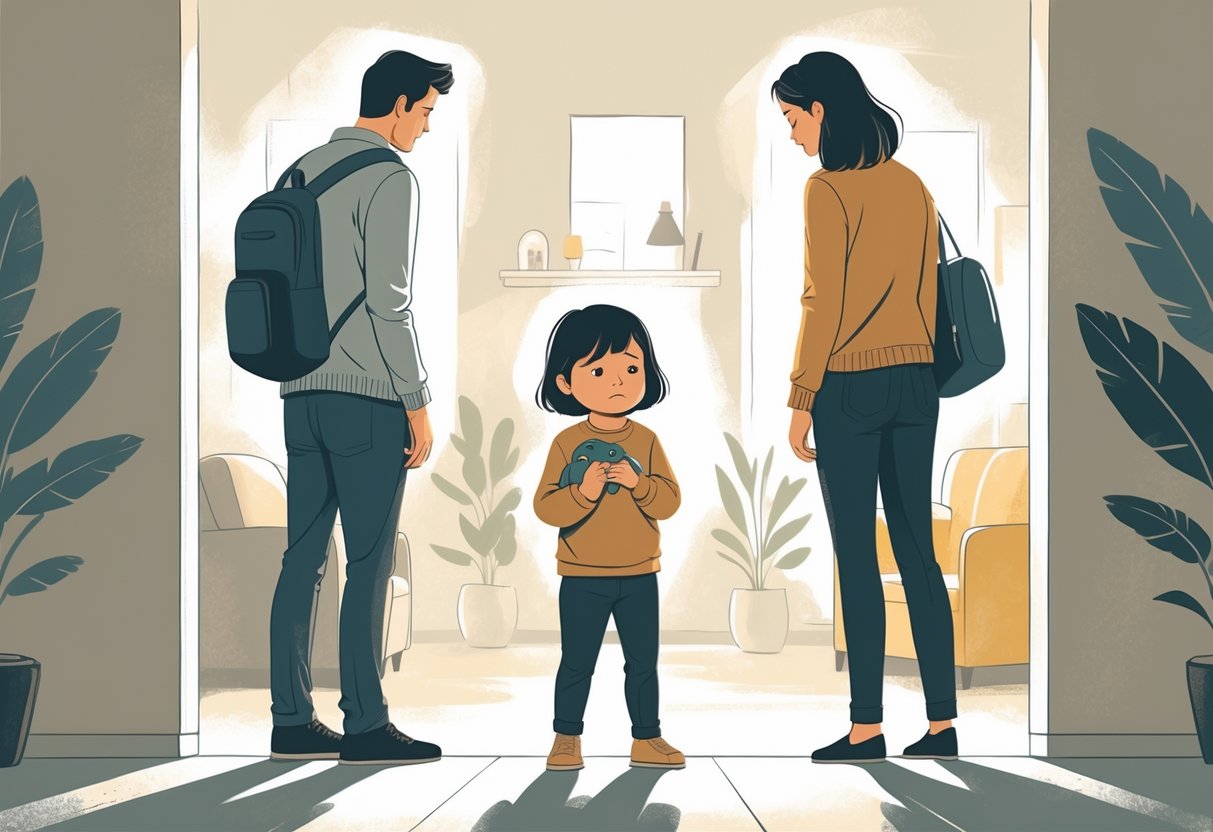
Divided loyalty is the big one. Many children feel that enjoying time with one parent is a betrayal of the other, and that tension can leave them guarded with both. That guilt is heavier when a child senses the parents are competing or hears one criticized. Chronic anxiety builds when home feels unpredictable or when arguments are in the air, even arguments the child cannot fully follow. And repeated conflict or feeling overlooked can chip at a child’s self-esteem until they read the family’s troubles as somehow their fault. The single most protective move a parent can make is to free the child from the middle — never as a messenger, never as a confidant about adult problems, never asked to choose. The guidance in how to support your child emotionally after separation goes deeper on validating these feelings without amplifying them.
What co-parenting dynamics make a child struggle?
A child’s distress usually traces back to the dynamic between the parents, not to the child. Poor communication, clashing parenting styles, and unresolved conflict are the three dynamics most likely to leave a child struggling.
When parents communicate badly, children get mixed messages, last-minute changes, and inconsistent rules — uncertainty that reliably breeds anxiety. When one home is strict and the other permissive with no shared baseline, the child is left testing two different sets of limits and unsure who to follow. And unresolved conflict is the most corrosive of all: a child used as a go-between, hearing one parent disparaged, or witnessing open hostility absorbs tension they have no power to fix — exposure the CDC counts among adverse childhood experiences tied to worse long-term outcomes. The fixes are within reach. Keeping communication factual and child-focused — the patterns in co-parenting communication strategies that work — removes much of the mixed-message problem, and reducing the conflict your child witnesses addresses the root cause directly. When the two of you genuinely cannot resolve disputes, co-parenting mediation gives the conflict a structured place to go that isn’t the child.
When should you get help, and what helps?
Get help when the signs are intense, last beyond a few weeks, or interfere with daily life — and don’t wait for a crisis to do it. Early support from a child therapist, a family counselor, or a mediator commonly keeps a manageable struggle from becoming a lasting one.

Start with steadier routines and lower conflict at home — for many children, predictability and a calmer atmosphere do most of the work. When that isn’t enough, a child therapist gives your child a neutral space and concrete coping tools, while family or co-parent counseling helps the adults communicate and align. The CDC’s guidance on children’s mental health outlines when professional evaluation is warranted, and the American Psychological Association underscores that a child’s adjustment hinges most on the conflict they’re exposed to — which is why getting the adults aligned often helps the child as much as treating the child directly. If a co-parent resists therapy your child clearly needs, frame it as support rather than criticism, and involve a mediator or seek legal advice if the impasse continues. Asking for help is a strength; the children who do best are usually the ones whose parents acted early.
Frequently Asked Questions
How can I help my child when they miss the other parent?
Let your child know it’s normal and okay to miss the other parent, and don’t treat it as a rejection of you. Encourage them to talk about the feeling, reassure them that both parents love them, and keep contact easy during time apart — a quick call or video chat between visits shortens the distance. Steady routines make the missing more bearable.
What should I do when my child says they want to live with the other parent?
Listen calmly and resist reacting in the moment — ask gentle questions to understand what’s really behind it, which is often a specific frustration rather than a settled wish. Raise your concerns privately with the other parent, not through the child. If the feeling persists or tension runs high, a family counselor can help everyone work through it.
How do I manage my own emotions while co-parenting?
Keep your focus on what’s best for your child, and use calm, neutral language during handoffs and messages even when you don’t feel calm. Lean on friends, a therapist, or a co-parenting class for support so the stress has somewhere to go that isn’t the child. Managing your own reactions is one of the most direct ways to steady your child.
What if my child gets upset about visiting the other parent?
Sit down and talk it through calmly, and look for what’s underneath — fear, confusion, or simply the difficulty of the switch. Work with the other parent on a predictable goodbye ritual or a small comfort that travels between homes. If the distress is strong or ongoing, rather than the usual transition jitters, consider a counselor to help you read it.
What if my co-parent refuses therapy our child needs?
Share your concerns clearly and frame therapy as help for the child, not a criticism of either parent’s care. Offer to choose the provider together. If the other parent still refuses and the child is clearly struggling, a family mediator can help you reach agreement, and in some situations legal advice is appropriate — a child’s documented need for support carries weight.
How long should I wait before getting a child help?
Brief distress around a separation or a transition is normal and usually eases within a few weeks as routines settle. Don’t wait, though, if the signs are intense, getting worse, or disrupting sleep, school, or friendships — or if your child expresses hopelessness. Early support is easier and more effective than waiting for a crisis to force the issue.