Updated: 2026-10-11
Quick answer: A divorce support group is a regular meeting, in person or online, where people going through separation or divorce talk with others in the same situation. Many are free, including church-based programs like DivorceCare, peer-led community groups, and groups found through 211, while therapist-led groups usually charge a fee. Parents can also choose structured programs focused on protecting their children, and separate groups exist for kids.
Note: This article is general information, not mental-health or legal advice. A support group is not a substitute for counseling or treatment. If you are in crisis or thinking about harming yourself, call or text 988 to reach the 988 Suicide & Crisis Lifeline.
The court paperwork has a checklist. Your lawyer, if you have one, has a timeline. Nobody hands you a plan for the Sunday night after the children leave for the other parent’s house and the place goes silent.
That gap is what divorce support groups fill. They will not handle your custody case, but they put you in a room, or a video call, with people who understand exactly what that Sunday night feels like. This guide covers the main types of groups, where to find online and local options, how to tell a good group from a bad one, and the programs built for children.
Table of Contents
- What is a divorce support group?
- Do divorce support groups actually help?
- What types of divorce support groups are there?
- Are there online divorce support groups?
- Are there divorce support groups for mothers and fathers?
- How do you find a divorce support group near you?
- How do you choose a good support group?
- Are there support groups for children of divorce?
- When is a support group not enough?
- Frequently Asked Questions
What is a divorce support group?
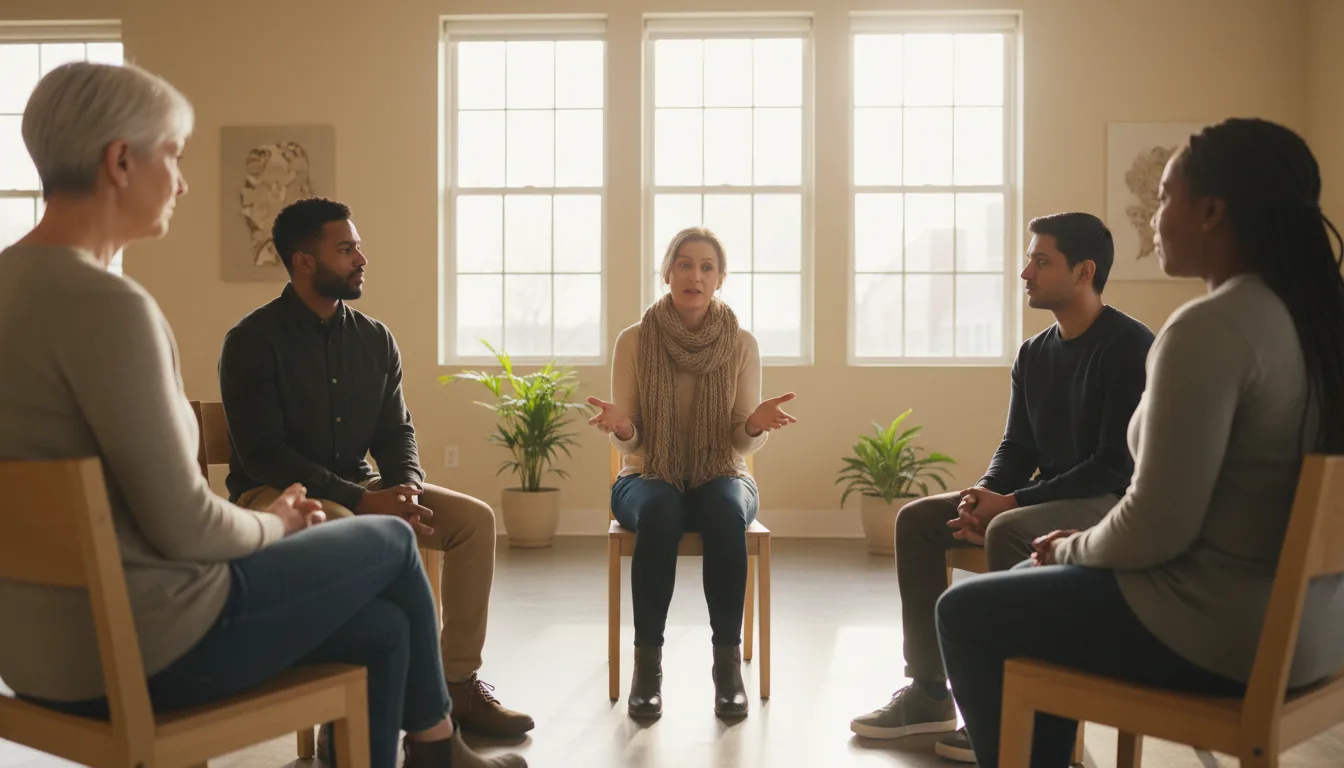
A divorce support group is a group of people going through separation or divorce who meet regularly to share experiences and practical advice. Most are led by trained volunteers or by people who have been through divorce themselves; some are led by licensed therapists. Groups meet weekly or every other week, in person or by video, and many follow a set series of topics over several weeks.
A support group is not therapy, and it is not legal advice. Members can tell you how they handled a first holiday apart, but not how a judge in your county will rule. The value is perspective and company: the realization that the anger, guilt, and relief you feel in the same afternoon are normal.
Do divorce support groups actually help?
For many people, yes, and the strongest evidence is for structured programs aimed at parents. In a randomized controlled trial published in JAMA, researchers followed families who took part in a group program for divorced mothers, with or without a parallel group for their children. Six years later, 11% of teenagers in the mother-plus-child program had a diagnosed mental disorder in the past year, compared with 23.5% in the control group, which received books on post-divorce adjustment.
That program became the New Beginnings Program, now offered by Arizona State University’s REACH Institute as eNew Beginnings, a fully online course with separate versions for mothers and fathers. It teaches four skills: doing positive activities as a family, listening so children share more, setting family rules, and protecting children from conflict between parents.
Peer-led groups have less formal research behind them, but they meet a different need: company and practical tips from people a few months further along. Many parents use both, a structured program for parenting skills and a peer group for themselves.
What types of divorce support groups are there?
Divorce support groups vary by who leads them, what they cost, and whether they focus on your own recovery or on your children.
| Type | Format | Typical cost | Best for | Example |
|---|---|---|---|---|
| Faith-based program | Weekly group, set video series | Usually free or a small fee for a workbook | People comfortable in a church setting | DivorceCare, a 13-week series run by churches, in person and online |
| Peer-led community group | Ongoing meetings or chapter events | Usually free | Ongoing company and practical tips | Parents Without Partners local chapters |
| Therapist-led group | Weekly group, set number of sessions | Fee per session; sometimes covered by insurance | Heavy emotional distress, anxiety, or depression | Groups at counseling practices and community clinics |
| Structured parenting program | Online or group course | Varies | Parents who want skills to protect their children | eNew Beginnings, 6 or 10 weeks online |
| Online forum or community | Message boards, chats, social media groups | Usually free | Late-night support and anonymity | Moderated forums run by nonprofits or programs |
| Group for children | Age-based group with activities | Often free | Children having a hard time with the change | DC4K, Rainbows |
Faith-based groups are among the easiest to find, because many churches host them. DivorceCare describes itself as a 13-week, video-based series, with groups that meet in person and online. It is openly Christian, which some members value and others prefer to avoid. If you would rather have a secular group, look at community centers, counseling practices, and the options through 211 below.
For single parents specifically, Parents Without Partners runs local chapters for single parents and their children, and it states plainly that it is not a dating organization.
Are there online divorce support groups?
Yes. Online groups are often the most practical option for parents, because they work around custody schedules, shift work, and the cost of a babysitter. Many faith-based and therapist-led groups now run a video version, and DivorceCare lists online groups alongside in-person ones. The eNew Beginnings parenting program is entirely online and self-paced.
Online groups come in two kinds:
- Structured video groups meet at a set time with a facilitator and a topic. They work like an in-person group, just on a screen.
- Open forums and social media groups are available around the clock, but quality varies widely. Look for active moderators and clear rules against harassment and selling.
One caution applies to every online group: assume anything you post could be read by your co-parent or shown in court. Screenshots travel. Vent about how you feel, not about the other parent by name, and never post about your children’s details or your custody case. Our custody evidence checklist explains how messages and posts end up in custody files.
Are there divorce support groups for mothers and fathers?
Yes. Some parents find it easier to talk in a group of people facing the same situation, and divorce support groups for women and groups for men are both common, especially through counseling practices and community organizations. Some structured programs are built this way too: eNew Beginnings has separate versions for fathers and mothers.
Fathers in particular sometimes struggle to find support, and they are often searching for practical information about parenting time at the same time. Our guide to fathers’ custody rights covers the legal side. For a group, call 211 and ask specifically about fatherhood programs, many of which combine peer support with parenting classes.

How do you find a divorce support group near you?
Start local and ask directly. These sources reliably turn up groups:
- Call or text 211. 211 is a free referral service run by United Way partners. Ask for divorce or separation support groups, single-parent groups, or fatherhood programs near you.
- Ask your family court. Many court self-help centers and family court services offices keep lists of local programs, often alongside the court-approved parenting classes they require.
- Ask a counselor or your doctor. Counselors know which local groups are well run, and many run groups themselves. Our guide to co-parenting counselors covers how to find one.
- Check faith communities. Churches, synagogues, and mosques often host groups that are open to anyone, not only members.
- Use a mental-health directory. Mental Health America publishes a guide to finding support groups, and many hospitals and community mental-health centers list their groups online.
- Check your employer’s benefits. An employee assistance program, if you have one, often offers a few free counseling sessions and referrals.
How do you choose a good support group?
Try a group two or three times before deciding. The first meeting is always awkward. After that, these signs tell you whether it is worth your time:
| Good signs | Warning signs |
|---|---|
| A trained facilitator keeps the conversation on track | One or two people dominate every meeting |
| Clear ground rules, including confidentiality | Members trade legal advice about each other’s cases |
| A mix of venting and practical problem-solving | Every meeting is a complaint session about exes |
| You leave feeling a little steadier | You leave angrier than you arrived |
| No pressure to buy anything | Upsells for coaching, courses, or products |
| Focus on healing and parenting | The group functions mainly as a dating scene |
It is also fine to switch. A group of people two years past their divorce may not fit someone whose spouse moved out last week, and the reverse is true too. Ask the facilitator who usually attends before you go.
Are there support groups for children of divorce?
Yes, and children often benefit from talking with other kids who have two homes. DC4K, from the makers of DivorceCare, is a 13-week program for children ages 5 to 12 whose parents are separating or divorcing, built around games, music, and crafts. It is offered through churches and is also free to download for parents to use at home. Rainbows for All Children trains facilitators to run peer-support groups for young people dealing with loss, including separation and divorce.
Your child’s school counselor is another good first stop. Many schools run small groups for students whose families are changing. For how to spot when a child needs more than a group, see how divorce affects children and our guide to talking to kids about divorce.
When is a support group not enough?
A support group is a good complement to professional help, but not a replacement for it. Look for a licensed counselor or therapist if, for more than a couple of weeks, you cannot sleep, eat, work, or care for your children the way you normally would, or if you are drinking more to cope. SAMHSA’s FindTreatment.gov lists mental-health and substance-use treatment providers by location.
If the problem is the co-parenting relationship itself, other services fit better. Our guide to co-parenting resources compares counseling, mediation, parenting coordinators, and classes. If you are afraid of your former partner, contact the National Domestic Violence Hotline at 1-800-799-7233, and see how domestic violence affects custody.
If you are in crisis or having thoughts of suicide, call or text 988 to reach the 988 Suicide & Crisis Lifeline, available 24 hours a day.
Frequently Asked Questions
Are divorce support groups free?
Many are. Church-based programs, peer-led community groups, and groups found through 211 are usually free or ask only for a small materials fee. Therapist-led groups charge per session, and some insurance plans cover them when they are part of mental-health treatment.
Is DivorceCare religious?
Yes. DivorceCare is a Christian program run through churches, and its materials include faith content. Groups are generally open to anyone who wants to attend. If you prefer a secular group, ask 211, a counselor, or a community mental-health center for other options.
Is an online or in-person divorce support group better?
Neither is better for everyone. In-person groups build stronger connections for many people, while online groups are easier to fit around custody schedules and work. Many parents start online and add an in-person group once their schedule settles.
Can what I say in a divorce support group be used in court?
It is possible. Peer support groups are generally not covered by the confidentiality protections that apply to licensed therapists, and other members are not bound by professional rules. Talk about your feelings rather than details of your case, and be even more careful in online groups, where posts can be screenshotted.
How long should I stay in a divorce support group?
As long as it helps. Many structured programs run for a set number of weeks, such as DivorceCare’s 13-week series, while peer groups are ongoing. Some people attend for a few months during the hardest stretch; others stay longer and eventually help newer members.
Are there divorce support groups for kids?
Yes. Programs like DC4K serve children ages 5 to 12, Rainbows for All Children supports young people through trained peer-support groups, and many school counselors run small groups for students whose parents are separating.
Reviewed by Nora Whitman, Managing Editor. Our research and review process explains how we source and verify the information in our guides.