Updated: 2026-10-15
Quick answer: You can file for divorce without a lawyer in every U.S. state by representing yourself, which courts call proceeding “pro se.” You get your state’s official divorce forms from the court’s self-help website, file the petition with the family court in your county, pay the filing fee or ask for a fee waiver, have someone else serve your spouse, exchange financial disclosures, and submit a signed agreement or attend a final hearing. It works best when you and your spouse agree on property, support, and parenting.
Legal disclaimer: This article is general information, not legal advice. Divorce forms, fees, and procedures are set by each state and sometimes each county. For decisions about your own case, check your court’s self-help center or talk to a family-law attorney licensed in your state.
A divorce lawyer can cost more than the car you are about to split. So it is fair to ask whether you need one at all. For a lot of couples, the answer is no. Family courts are built around people filing on their own, and the official forms are free.
The catch is that “free forms” is not the same as “easy.” This guide shows you how to file for divorce without a lawyer from start to finish: when it is a realistic plan, the exact sequence of steps, where to get free help, and the paperwork mistakes that most often bring people back to court. For the overall divorce process, see our step-by-step pillar guide to how to get a divorce.
Table of Contents
- Can you file for divorce without a lawyer?
- When does a divorce without a lawyer make sense?
- How do you file for divorce without a lawyer, step by step?
- What forms do you need for a DIY divorce?
- Where can you get free help without hiring a lawyer?
- What is limited-scope legal help, and when is it worth it?
- What mistakes do people make filing for divorce themselves?
- What changes if you have children?
- Frequently Asked Questions
Can you file for divorce without a lawyer?
Yes. Every state lets you represent yourself in a divorce, and in most family courts self-representation is the normal situation, not the exception. Representing yourself is called proceeding pro se, Latin for “for oneself”, and family courts see it every day.
The numbers bear that out. A national study of family court cases by the Institute for the Advancement of the American Legal System found that 72% of cases involved at least one self-represented party. California’s court guide says plainly that it is possible to complete the process without a lawyer, while suggesting you hire one, at least for those parts of the case, if you have a lot of property or debt.
Representing yourself does not mean the court relaxes its rules for you. Clerks and self-help staff can explain procedure and point you to forms, but they cannot tell you what to ask for. The deadlines, the service rules, and the disclosure requirements apply to you exactly as they would to an attorney.
When does a divorce without a lawyer make sense?
A divorce without a lawyer works best when you and your spouse agree on every issue, have modest and simple finances, and have no history of abuse. The more you disagree, and the more complex the property, the more a mistake can cost you.
Use this table to judge your own situation:
| Your situation | Doing it yourself | Why |
|---|---|---|
| You agree on everything, no children, few assets | Very realistic | Forms are standardized and many states offer a simplified track |
| You agree on everything and have children | Realistic with care | You add a parenting plan and child support worksheet, and often a parenting class |
| You own a house, retirement accounts, or a business | Get at least limited legal help | Dividing a pension or a business often takes a separate order or a valuation |
| Your spouse has hired a lawyer | Get legal help | You would be negotiating against a professional on every term |
| Custody is disputed | Get legal help | Hearings, evidence, and possibly a custody evaluation are involved |
| There is domestic violence or coercive control | Talk to a lawyer or legal aid first | Safety planning and protective orders come before paperwork |
If you land in the bottom rows, you still do not have to choose between doing everything yourself and paying a full retainer. The limited-scope option covers the middle ground. For the different routes a divorce can take, including the simplified summary procedures some states offer, see our guide to the types of divorce.
How do you file for divorce without a lawyer, step by step?
To file for divorce without a lawyer, you confirm you meet residency rules, get your state’s official forms, file the petition, serve your spouse, exchange financial disclosures, settle the terms in writing, and submit the final paperwork once your state’s waiting period has passed. The labels change from state to state; the order does not.
Here is the sequence, using California’s court forms as the running example because its self-help guide is the most detailed:
- Confirm you can file in your state and county. Most states require that you or your spouse have lived there for a set time. California requires six months in the state and three months in the county. Texas requires six months in the state and 90 days in the county.
- Decide which route fits. If you agree on everything, look for an agreed, uncontested, or simplified procedure. If you do not, you will file a standard petition and work toward agreement as the case moves.
- Get the official forms. Start with your state court’s self-help site or statewide legal-aid site. Some states offer free guided interviews that fill in the forms from your answers, such as Michigan Legal Help’s Do-It-Yourself Divorce tool.
- Fill out and file the petition. In California, that is the Petition (FL-100) and the Summons (FL-110), plus a custody jurisdiction form (FL-105) if you have children under 18. Make copies before you file.
- Pay the filing fee or ask for a waiver. California’s fee is $435 to $450. If you cannot afford it, every state has a way to ask the court to waive it; California’s process is on its fee waiver page, and our divorce fee waiver guide covers the forms and income limits in other states.
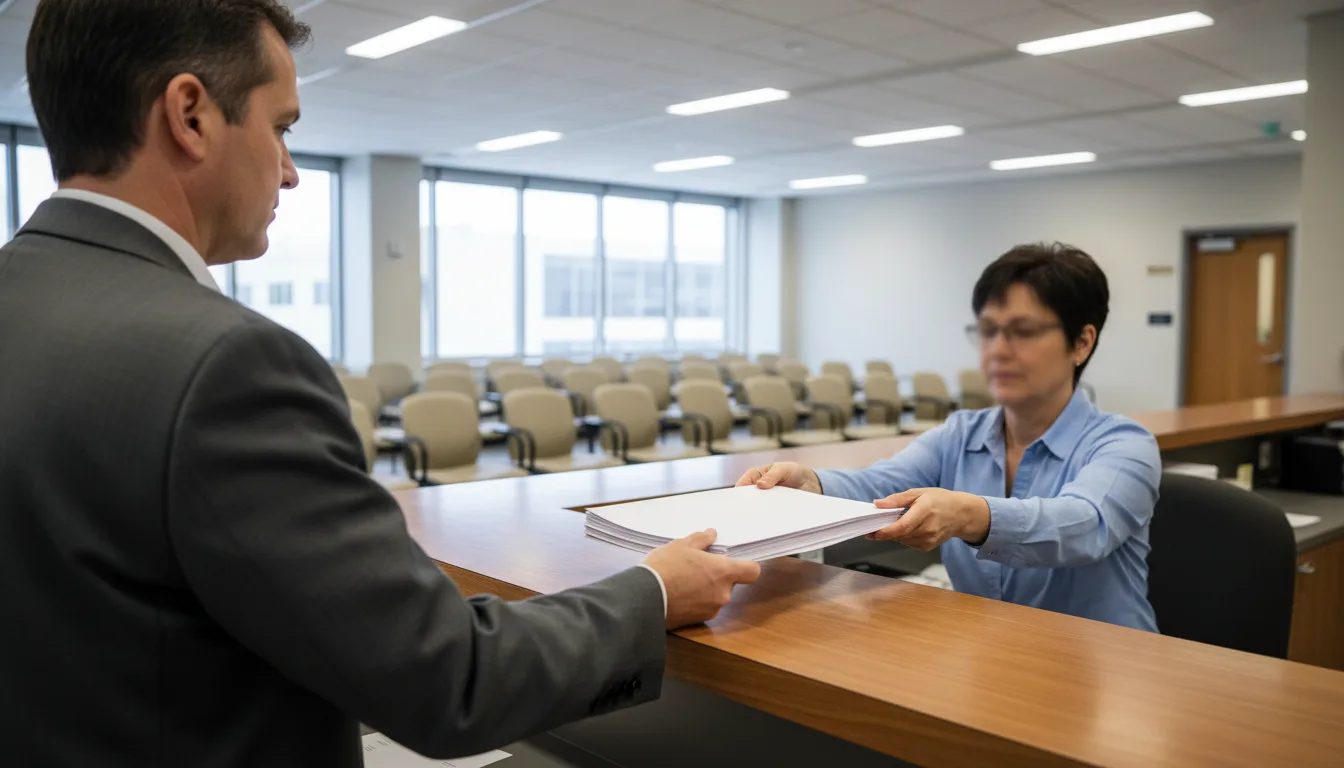
- Have your spouse served. You cannot hand the papers over yourself. In California, the server must be 18 or older and not part of your case: a friend, relative, professional process server, or sheriff. The server then signs a proof of service that you file.
- Exchange financial disclosures. Both spouses list income, expenses, property, and debts on standard forms. Skipping this step is one of the most common reasons a judge sends paperwork back.
- Finish with an agreement or a hearing. If you agree on everything, you write and sign a settlement agreement and submit it with the final judgment forms. If you do not, the court schedules hearings and, eventually, a trial.
Your state’s waiting period controls how soon the judge can sign. Texas cannot grant a divorce until 60 days after filing in most cases; California’s marriage cannot end until six months after service. Our guide to how long a divorce takes has the waiting period for six large states and a step-by-step timeline.
What forms do you need for a DIY divorce?
A DIY divorce needs the same core documents in every state: a petition, a summons, proof of service, financial disclosures, a settlement agreement if you have one, and a proposed final judgment. Names and form numbers vary, and many counties add local forms of their own.
| What the document does | Common names | California example |
|---|---|---|
| Starts the case and says what you want | Petition, complaint, original petition | FL-100 |
| Notifies your spouse and sets the response deadline | Summons, citation | FL-110 |
| Tells the court where the children live | UCCJEA declaration | FL-105 |
| Asks the court to waive fees | Fee waiver request, affidavit of indigency | FW-001 |
| Proves your spouse received the papers | Proof of service, return of service, waiver of service | FL-115 |
| Lets your spouse answer | Response, answer | FL-120 |
| Shows each spouse’s finances | Financial disclosure, financial affidavit | Disclosure forms |
| Records the terms you agreed to | Settlement agreement, marital settlement agreement | Written agreement |
| Ends the marriage | Final judgment, decree of divorce | Judgment forms |
Two warnings about forms. First, use your own state’s versions; a form downloaded from another state, or from a generic website, can be rejected outright. Second, check for local forms. California’s court guide tells filers to check the court’s website, call the clerk, or ask the self-help center before filing, because some courts require additional local forms.
Where can you get free help without hiring a lawyer?
Your first stop is your court’s self-help center, which gives free legal information on forms and procedure to people without a lawyer. Statewide legal-aid websites, legal aid organizations, and court e-filing portals fill most of the remaining gaps.
- Court self-help centers. California runs one in every county; you can find your local self-help center by city or zip code. Many courts in other states offer the same service in person, by phone, or online. Staff explain procedure but do not represent either spouse.
- Statewide legal-aid websites. Sites such as TexasLawHelp.org, Michigan Legal Help, and Illinois Legal Aid Online publish plain-language guides and free form tools. Our pillar guide lists where to find divorce forms for the ten most populous states.
- Free legal aid. If your income is low, a legal aid organization may help or represent you. The Legal Services Corporation funds legal aid in every state and offers a search tool to find legal aid near you. Demand is high: LSC’s 2022 research found that 92% of the civil legal problems of low-income Americans received no or not enough legal help, so apply early.
- Electronic filing. Many states let self-represented filers submit forms online. In Texas, e-filing is mandatory for attorneys, and the state’s portal says that non-attorney filers are encouraged to use it too, through eFileTexas.gov.
Be careful with paid online divorce services. Some simply fill in the same free court forms for a fee, and none of them can give you legal advice. Check your state’s free official tools first, then decide whether the convenience is worth paying for.

What is limited-scope legal help, and when is it worth it?
Limited-scope representation means hiring a lawyer for only part of your divorce, such as reviewing your settlement agreement or handling one hearing, while you do the rest yourself. It is also called unbundled legal services, and it lets you buy targeted help at a lower total cost than full representation.
Cornell’s Legal Information Institute describes limited scope representation as a lawyer taking on only some part of a client’s matter, and notes that divorce is one of the most common uses. California sets out the rules in Rule 5.425 of the California Rules of Court, which recognizes two types:
| Type | What the lawyer does | Does the court know? |
|---|---|---|
| Noticed limited scope | Appears for you on specific issues, such as property division or one hearing | Yes; you file a Notice of Limited Scope Representation (FL-950) |
| Undisclosed limited scope | Drafts or helps draft your documents behind the scenes | No; the lawyer does not appear in the case |
Limited-scope help earns its cost at three points. The first is before you sign a settlement agreement, because that document controls your finances for years. The second is when retirement accounts are divided, since a workplace retirement plan usually needs its own court order, called a qualified domestic relations order, before it can pay a former spouse. The third is any contested hearing. For how family lawyers bill and when full representation is the better choice, see our guide to what a family lawyer does. Many couples also bring in a neutral mediator to settle the terms and then file the paperwork themselves; our guide to custody mediation explains how that works.
What mistakes do people make filing for divorce themselves?
The most common DIY divorce mistakes are procedural: serving papers the wrong way, skipping financial disclosures, missing local forms, and signing vague agreements. Each one can delay the case or leave a problem that surfaces years later.
- Serving the papers yourself. Service by a party is invalid in most states. Use an adult who is not part of the case, a sheriff, or a process server, and file the proof of service.
- Ignoring the response deadline. In California, your spouse usually has 30 days after service to respond. If they do not, you can ask for a default, and the court can then divide property, set support, and make custody orders without hearing from them. If you are the one served, do not let that deadline pass by accident.
- Treating disclosures as optional. Exchanging financial information is required even when you agree on everything. California’s guide for couples who settle without a Response calls full and current disclosure required.
- Writing vague terms. “We will split the retirement fairly” cannot be enforced. Name the account, the percentage or amount, the valuation date, and who prepares any transfer order.
- Forgetting debts and the house. A judgment can assign a car loan to your spouse, but the lender can still pursue whoever signed the loan. Refinancing or selling is usually the only way to fully separate the debt.
- Using the wrong state’s forms. Generic or out-of-state forms are a fast way to have your filing rejected at the counter.
What changes if you have children?
If you have minor children, your divorce paperwork adds a parenting plan, a child support calculation, and in many states a required parenting class. Couples with children are also usually excluded from the simplest summary divorce tracks.
The parenting plan is the document you will use most after the divorce, so write it as if you will be reading it at 8 PM on a disputed holiday. Our parenting plan template covers the sections courts expect. Child support follows your state’s guideline formula; our explainer on how child support works walks through the models. If your county requires a parenting course, our guide to court-approved parenting classes explains how to confirm the court accepts the class you pick.
Agreement on these terms is what keeps a self-filed divorce simple. If you cannot agree on where the children will live, the custody part of the case will likely need hearings, and that is the point where legal help usually pays for itself.
Frequently Asked Questions
Can I file for divorce online without a lawyer?
Often, yes. Many states let self-represented filers submit divorce forms through a court e-filing portal, and some courts also offer guided online interviews that fill in the forms for you. Texas, for example, invites non-attorney filers to use eFileTexas.gov. Check your county court’s website, because e-filing availability varies by court.
How much does it cost to file for divorce without a lawyer?
The main cost is the court filing fee, which is set by each state and county; in California it is $435 to $450. Add a few dollars for copies and, if you use one, a process server or sheriff’s fee. If you cannot afford the filing fee, every state lets you ask the court to waive it.
What happens if my spouse doesn’t respond to the divorce papers?
If your spouse is properly served and does not respond by the deadline (usually 30 days in California), you can ask the court for a default. The judge can then end the marriage and decide property, support, and custody based on your paperwork, so a default is only appropriate if your requests are fair and complete.
Can my spouse and I share one lawyer for an uncontested divorce?
Generally no. A lawyer can represent only one spouse in a divorce, because your interests conflict even when you agree. One spouse can hire a lawyer while the other represents themselves, or you can both work with a neutral mediator who helps you reach terms but represents neither of you.
Do I have to go to court for a DIY divorce?
Not always. In many uncontested cases, the judge signs the final judgment based on the paperwork alone. Some states and counties require a short final hearing, where one spouse confirms the basic facts under oath. Your court’s self-help center can tell you whether your county requires one.