
A co-parenting safety plan is a written, step-by-step framework that protects you and your children across exchanges, communications, and day-to-day life with a former partner who is unsafe, controlling, or escalating. It is not a single document. It is a small set of practiced routines, paired with documentation, that hold up under stress and read clearly to a judge if you ever need to show one.
Updated: 2026-05-21
If you or your children are in immediate danger, call 911. The National Domestic Violence Hotline is available 24/7 at 1-800-799-7233 (or chat at thehotline.org).
Legal disclaimer: This article is general information, not legal or therapeutic advice. Laws on protective orders, custody, and address confidentiality vary by state and country. For decisions about your specific case, work with a family law attorney and a domestic violence advocate licensed in your jurisdiction.
Quick answer: A co-parenting safety plan is a written, step-by-step framework that protects you and your children across exchanges, communication, and daily life with a former partner who is unsafe, controlling, or escalating — not a single document but a small set of practiced routines paired with documentation. It typically covers six areas: personal safety, custody exchanges, communication, a child-side plan, court-ready documentation, and the legal protections (like protective orders and address confidentiality) that back the rest up. Domestic violence advocates have used the framework for decades, and family courts increasingly treat a written safety plan as evidence that a protective parent is acting reasonably, not “alienating.”
Table of Contents
- What a Co-Parenting Safety Plan Actually Is
- Step 1: Assess Your Risk Honestly
- Step 2: Build Your Personal Safety Plan
- Step 3: Plan for Custody Exchanges
- Step 4: Build a Communication Safety Plan
- Step 5: Build a Child-Side Safety Plan
- Step 6: Document Everything for Court
- Step 7: Legal Protections That Reinforce Your Plan
- When the Plan Has to Change
- Frequently Asked Questions
What a Co-Parenting Safety Plan Actually Is
A safety plan is a working document, not a one-time exercise. It typically covers six areas: personal safety, custody exchanges, communication, a child-side plan, documentation, and the legal protections that back the rest of it up. Domestic violence advocates have used the framework for decades — the federal Office on Women’s Health publishes a step-by-step safety-planning guide built on the same approach. Family courts increasingly accept written safety plans as evidence that a protective parent is acting reasonably, not “alienating.”
You need a safety plan if any of these are true:
- You are leaving, or have recently left, a relationship that included physical violence, threats, strangulation, weapons, or stalking.
- The other parent uses coercive control and custody tactics — monitoring, isolation, financial control, or rule-setting that escalates after separation.
- There is a history of court-recognized abuse and you now share custody.
- The other parent has threatened to take the children, harm pets, harm themselves, or expose private information.
A safety plan is not the same as a restraining order. It is what you do whether or not a judge has signed an order.
Step 1: Assess Your Risk Honestly
The most dangerous window in an abusive relationship is the period during and immediately after separation. Risk does not always drop after you leave; it often spikes. A clear-eyed assessment is the foundation of every other step.
The Danger Assessment developed by Dr. Jacquelyn Campbell at Johns Hopkins is the most widely used screening tool for intimate-partner homicide risk. It is free at dangerassessment.org and can be completed with or without an advocate. Higher scores correlate with serious harm; they do not predict your future, but they should shape how cautious your plan is.
Lethality factors that materially raise risk include:
- Strangulation, even once
- Access to firearms in the household
- Threats to kill you, the children, or themselves
- Sexual assault inside the relationship
- Recent escalation in frequency or severity
- Forced sex, stalking, or surveillance behavior
- A new partner in your life
- A pending or recent separation
Work with a domestic violence advocate as you complete the assessment. Local DV programs offer free, confidential safety planning by phone, chat, or in person. The National Domestic Violence Hotline can connect you to a local advocate in any U.S. state.
Step 2: Build Your Personal Safety Plan
This layer is about you — your physical safety, your finances, your phone, and your home.
- Housing. Know where you would go in an emergency. Keep a small “go bag” with copies of IDs, the kids’ birth certificates, custody paperwork, prescription medications, a phone charger, and one change of clothes per child. Store it somewhere the other parent cannot access.
- Money. Open a bank account in your name only. Re-route any deposits. Memorize one credit card number. The National Network to End Domestic Violence’s Safety Net project has detailed financial safety guides.
- Documents. Make digital and physical copies of passports, social security cards, custody orders, protective orders, school records, and medical records. Store the digital copies in a cloud account the other parent does not know about.
- Communications. Change passwords on every email, social, and financial account. Sign out of every device the other parent might still have access to. Replace shared devices when possible.
- Digital safety. Audit shared phone plans, location-sharing apps, smart-home cameras, car telematics, and joint Apple or Google accounts. Stalkerware can be installed in under five minutes. If you suspect monitoring, get the device checked rather than scrubbing it yourself, which may destroy evidence.

Step 3: Plan for Custody Exchanges
Exchanges are the single highest-risk moment in a co-parenting schedule because they put both parents in the same place at a predictable time. Treat them as engineering problems.
- Use a neutral, public, recorded location. Police-station lobbies are the most common — many departments designate lobbies as “safe exchange zones.” Other workable options include the entrance of a public library, a busy cafe, or a courthouse lobby during business hours.
- Use a supervised exchange center if available. Many counties have programs that handle exchanges and visitation in separate rooms so the parents never see each other. Search “supervised visitation center” plus your county.
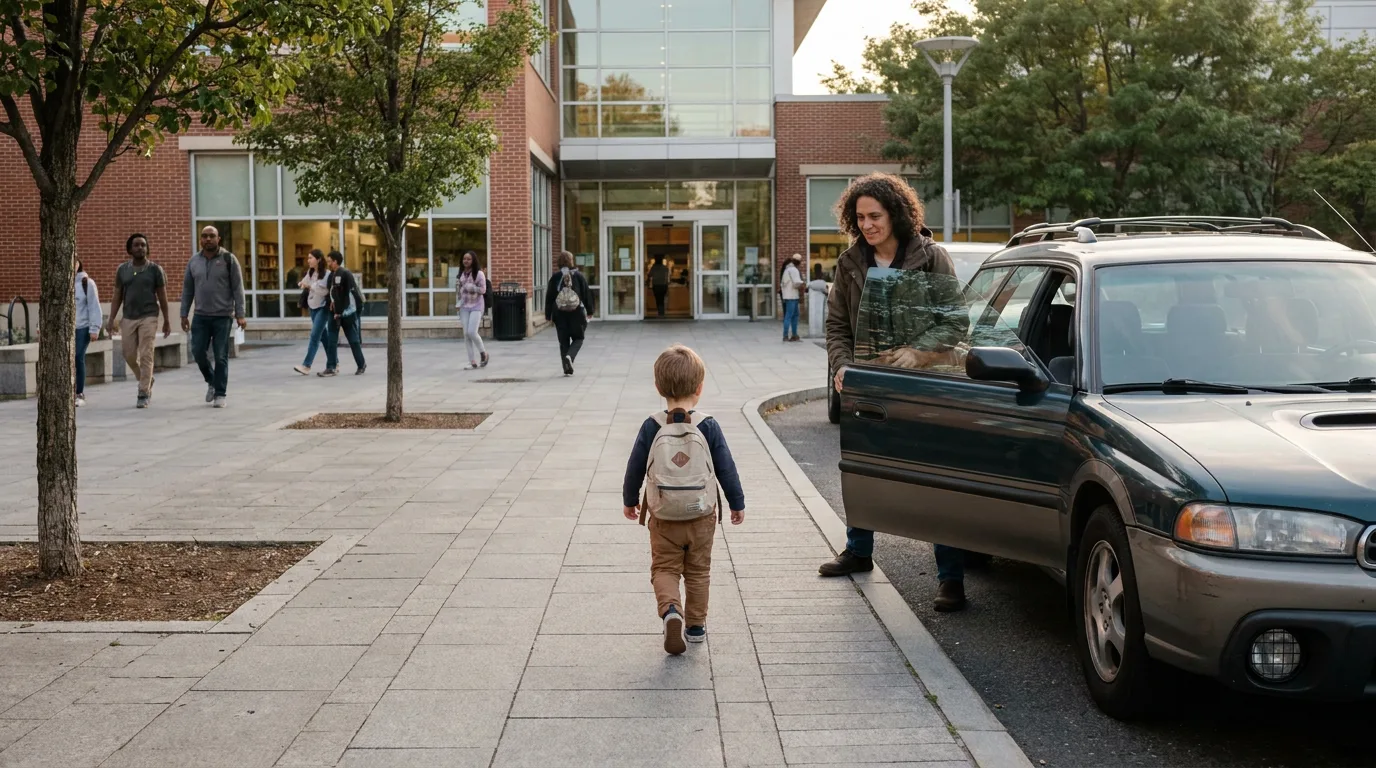
- Curbside, not front-door. The child walks to the other parent’s car; the parents do not interact at the threshold.
- Use a third-party exchange agent. A trusted family member or friend can collect and deliver the child so you never need to be present together. Pick someone steady, who will not engage in conflict.
- Time and route discipline. Vary your route home. Do not post real-time location on social media. Confirm the exchange in writing afterward (“Children received at 6:02 PM. Both healthy and in good spirits.”).
If the other parent is escalating, request a court order that specifies the exchange location and conditions. Vague orders (“parties shall exchange at a mutually agreed location”) let the unsafe parent dictate the terms at every handoff. Specific orders (“exchanges shall occur at the [City] police station main lobby Sundays at 6:00 PM”) remove the negotiation.
Step 4: Build a Communication Safety Plan
The goal is to make every interaction text-based, time-stamped, child-focused, and reviewable by a judge.
- Move all contact onto a documented channel. Court-recognized apps like OurFamilyWizard, Talking Parents, and AppClose record messages and timestamps and cannot be edited after the fact. Disable phone calls and personal texts where the order allows.
- Use the BIFF method. Brief, Informative, Friendly, Firm. Developed by attorney Bill Eddy at the High Conflict Institute, BIFF replies refuse the bait without escalating. No paragraphs of feeling. No counter-attacks. Facts, schedule, child welfare, end.
- Set a response cadence. Reply within 24 hours for routine messages and within two hours for urgent child-safety questions. Anything else can wait until your next set window.
- Save and back up. Export the message log monthly to a PDF and save it outside the app. If the app’s subscription lapses, you still have the record.
For high-conflict and post-DV situations, see the dedicated guide on structured parallel parenting.
Step 5: Build a Child-Side Safety Plan
Children need their own version of the plan, tuned to their age. The goal is not to make them anxious; it is to give them clear, boring instructions so they know what to do.
- Code words. Agree on a short word the child can text or say on a phone call to signal “come get me, something is wrong.” Practice it once, not repeatedly.
- Emergency contacts. Program three numbers into the child’s phone, watch, or printed list: you, a trusted adult who lives nearby, and 911. For younger kids, a laminated card in their backpack.
- What to do at the other parent’s house. Reassure them that safety rules apply everywhere — buckling up, not opening the door to strangers, knowing the address. Avoid framing the other parent as the threat unless the child has already named that themselves.
- Tell the school, daycare, and pediatrician. Provide a copy of the custody order. Provide a copy of any protective order. Name the adults who are authorized for pick-up. Many schools will refuse pickup by an unauthorized parent if the order is clearly on file.
- When supervised contact is the right ask. If the child has been physically harmed, threatened, or exposed to violence, supervised visitation may be appropriate. The threshold is lower than many parents realize; consult an attorney and review the how domestic violence affects custody guide.

Step 6: Document Everything for Court
Documentation is what separates a safety plan from a wish. Family courts give weight to contemporaneous, dated, specific records.
- Custody journal. A dated log of exchanges, conversations, missed calls, and incidents. One short entry per event, written the same day. Keep it factual.
- Screenshots. Capture every text, voicemail transcript, and app message that contains threats, schedule violations, or coercive language. Include the timestamp and sender info in the frame.
- Photos. Photograph any injury, damage to property, or unsafe condition at handoff. Save originals with EXIF data intact.
- Witnesses. Note who was present at any incident, with name and contact. Friends, family, neighbors, teachers, and exchange agents can all be witnesses.
- Police reports and medical records. Request copies of every report you have filed. They are routinely lost or not produced by the other side at trial.
The coercive control and custody guide has a longer treatment of evidence patterns that work in family court.
Step 7: Legal Protections That Reinforce Your Plan
A written plan is stronger when it is backed by an enforceable order.
- Civil protective orders. Sometimes called restraining orders, orders of protection, or stay-away orders depending on the state. Most states allow you to include the children. The American Bar Association’s Commission on Domestic & Sexual Violence maintains a state-by-state map of civil protection statutes.
- Specific custody-order language. Ask the court for orders that name the exchange location, the communication channel, the response windows, and the consequences for violation. Vague orders are unenforceable.
- Address confidentiality programs (ACP). At least 40 U.S. states run programs that let survivors use a substitute mailing address with state agencies. Schools, courts, the DMV, and the voter rolls then route mail without exposing your real address. Search your state plus “address confidentiality program.”
- Firearms surrender. Federal law and most state laws require respondents to surrender firearms after a qualifying protective order. Ask your attorney to push for an explicit surrender provision.
When the Plan Has to Change
A safety plan is not a static document. Re-open it when any of these happen:
- The other parent escalates — new threats, new stalking behavior, a new restraining-order violation.
- The other parent gets a new partner, loses housing, loses a job, or starts using substances.
- A child says or does something that suggests they are being harmed, coached, or used as a messenger. (More on this in the co-parenting with a narcissistic ex guide.)
- Your court order changes.
- You move or change phone numbers.
Re-running the Danger Assessment every 6–12 months, with an advocate, is reasonable practice.
Frequently Asked Questions
What should be included in a co-parenting safety plan?
Six layers: personal safety (housing, money, documents, phones), exchange logistics (neutral public location, third-party agent, time discipline), a written-only communication channel, an age-appropriate child-side plan with code words and authorized contacts, contemporaneous documentation, and the legal protections (custody order language, protective order, address confidentiality program) that make the rest enforceable.
How do you do safe custody exchanges with an abusive former partner?
Use a neutral, recorded, public location — police-station lobbies and supervised exchange centers are the most common. Do curbside, not front-door. Use a third-party exchange agent whenever you can. Ask the court for an order that names the location and time so the unsafe parent cannot renegotiate at the threshold.
Can I request a safety plan in a custody order?
Yes. Courts can incorporate specific safety provisions into a parenting plan — exchange location, communication channel, response windows, supervised visitation, no-contact provisions, and consequences for violations. Vague orders are difficult to enforce; specific ones are not. Work with a family law attorney in your state.
Is a safety plan the same as a restraining order?
No. A restraining order is a court-issued document with criminal consequences for violation. A safety plan is what you do regardless of whether you have an order. The two work best together: the order sets the legal floor, the plan handles the day-to-day.
Should I tell my children about the safety plan?
Give them the parts they need. Code words, emergency contacts, and what to do if they feel unsafe — yes. The risk assessment, your fears, the legal strategy — no. Frame the plan as a normal household routine like fire drills, not as something that signals constant danger.
How long does a co-parenting safety plan stay in place?
Until the risk factors have meaningfully changed. Many protective parents keep core elements — documented communication, neutral exchanges, the journal — in place for the entire duration of the co-parenting relationship, especially in post-coercive-control situations.
If you or your children are in immediate danger, call 911. The National Domestic Violence Hotline is available 24/7 at 1-800-799-7233. Chat support and a state-by-state advocate locator are at thehotline.org.