
Updated: 2026-06-01
Quick answer: A communication app helps you set boundaries after divorce by giving structure where willpower alone struggles: it confines communication to one documented channel, separates child logistics from personal conflict, and creates a record that discourages boundary-pushing. Used well, it lets you limit when and how your ex contacts you, keep exchanges to child-related topics, and stay calm because there’s no live, emotionally charged back-and-forth. The app doesn’t enforce boundaries by itself — you do, through consistent behavior — but it makes them far easier to hold, especially with an ex who tests them.
Disclaimer: This article is for general information only and is not legal, medical, or psychological advice. Custody and family law vary by state and country. For decisions affecting your children or your case, consult a licensed family attorney and, where appropriate, a qualified mental health professional.
After a divorce, the hardest boundary to hold is often the one with your former partner. The old patterns of communication — the late-night texts, the calls that turn into arguments, the messages that drag up the past — don’t end just because the relationship did.
A communication app can’t change your ex, but it can change the structure you both operate in, and structure is what makes boundaries stick. This guide covers why post-divorce boundaries are so hard, how a documented channel supports them, which specific boundaries it helps you hold, and what to do when your ex pushes back.
Table of Contents
- Why are communication boundaries so hard after divorce?
- How does a documented channel support boundaries?
- Which boundaries can a communication app help you hold?
- How do you set boundaries with the app, not just the person?
- What if your ex resists the boundaries?
- Frequently Asked Questions
Why are communication boundaries so hard after divorce?
Communication boundaries are hard after divorce because the emotional patterns of the relationship outlast it, and the usual channels — texting, calling, in-person remarks — invite the very behavior you’re trying to limit. Raw feelings plus an open channel is a recipe for boundary violations.
The dynamic is familiar: a message about the schedule becomes an argument about the past, a quick call turns into an hour of conflict, and the constant accessibility means there’s no natural limit on when or how the contact happens. Both parents may slip into old roles without meaning to. This matters beyond your own peace, because the conflict it generates reaches the child — the American Psychological Association ties children’s post-divorce adjustment to the conflict they witness. Setting boundaries is therefore not about being cold; it’s about protecting both yourself and your child from a pattern that serves no one. The broader principles are in boundaries every co-parent should set, and the emotional side of disengaging from the relationship in how to emotionally detach from your ex while co-parenting.
How does a documented channel support boundaries?
A documented channel supports boundaries by replacing willpower with structure — it makes the boundary part of the system rather than something you have to defend in every interaction. The channel itself does some of the enforcing.
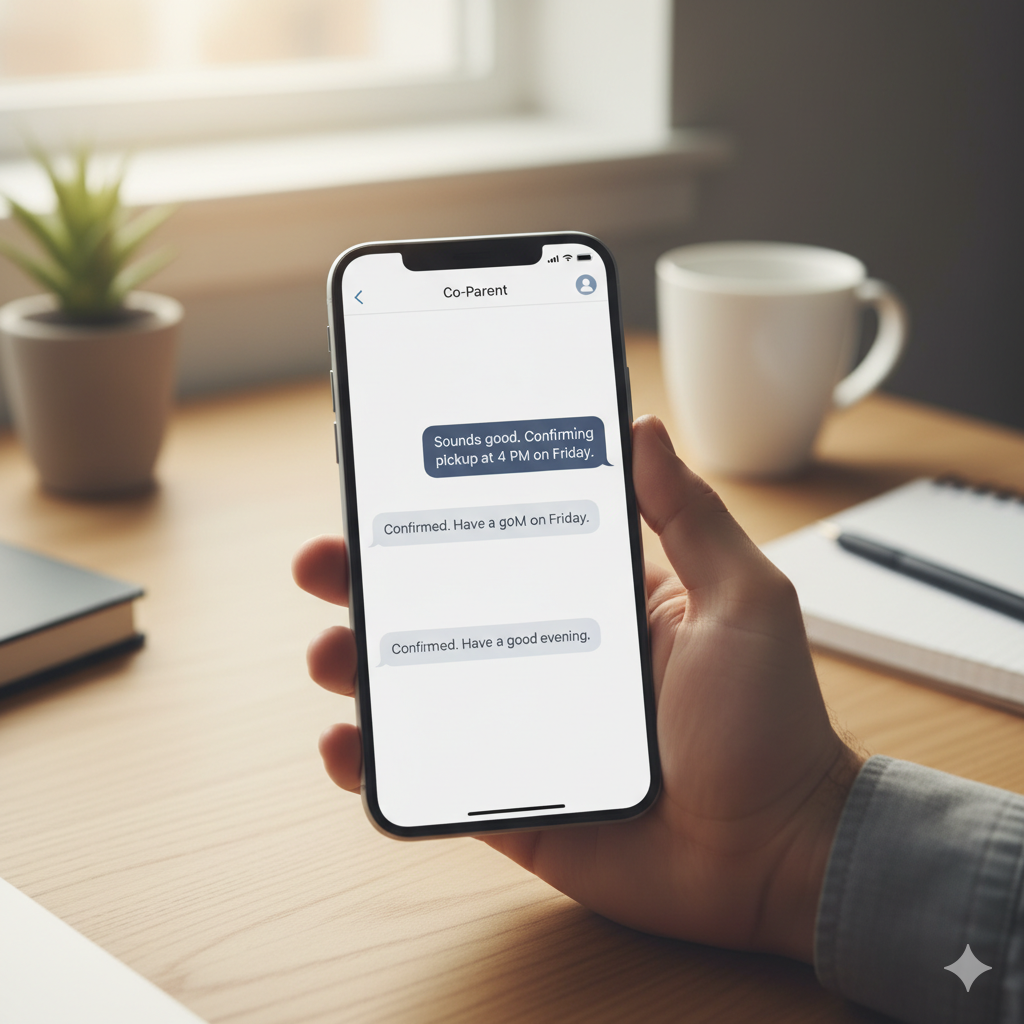
When all communication runs through one documented app, several boundaries become almost automatic. There’s no late-night call to take because contact happens in a channel you check on your terms. The written, time-stamped format discourages hostility, because both parents know it’s on the record. And the app separates child logistics from personal conflict by design, so a scheduling message doesn’t open the door to relationship grievances. That documentation also has weight if conflict escalates — the accountable records fit the standards developed by the Association of Family and Conciliation Courts and used by courts. The structure is what makes the difference: instead of holding a boundary through sheer discipline against an ex who tests it, you let the channel hold much of it for you. The conflict-reduction mechanics are detailed in how co-parenting apps help reduce conflict.
Which boundaries can a communication app help you hold?
A communication app helps hold the boundaries that are hardest to maintain by willpower alone: when contact happens, how it happens, what it’s about, and the tone it takes. Each maps to a feature or a feature-supported habit.
The table below pairs common post-divorce boundaries with how an app supports them.
| Boundary | How the app supports it |
|---|---|
| Contact on your terms, not at all hours | Asynchronous messaging you check when ready — no live calls |
| Communication in one place only | A single channel replaces scattered texts, calls, and emails |
| Topics limited to the children | Business-like format; conversations sorted by subject |
| Calm, non-hostile tone | Documented record and, in some apps, tone alerts |
| No relitigating the relationship | Logistics separated from personal threads by design |
| A record of what was agreed | Time-stamped, tamper-evident logs |
The throughline is that the app converts a boundary you’d otherwise have to defend repeatedly into a default built into how communication works. You still set and uphold the boundary, but the structure carries much of the load — which is exactly what makes it sustainable with a boundary-pushing ex.
How do you set boundaries with the app, not just the person?
Set boundaries by establishing the app as the rule, not the exception — agree that co-parenting communication happens there, define what it’s for, and hold to it. The boundary is “this channel, these topics,” and the app makes it concrete.
A few moves make it work. First, make the app the single channel: communicate about the child there, and stop responding to off-channel attempts to pull you into texts or calls, which is how boundaries erode. Second, define the scope explicitly — communication is about the children and logistics, not the relationship — and simply don’t engage with messages that stray. Third, set your own contact rhythm: because messaging is asynchronous, you can check and respond at set times rather than reacting instantly, which removes the all-hours accessibility that fuels conflict. Keep your own messages brief, factual, and child-focused, modeling the tone you want, using the patterns in co-parenting communication strategies that work. The boundary lives in your consistent behavior; the app just makes that behavior easier to sustain.
What if your ex resists the boundaries?
If your ex resists the boundaries, hold them through your behavior rather than through argument — don’t engage off-channel, don’t justify the boundary repeatedly, and let the documented structure absorb the pushback. Resistance is common and doesn’t mean the boundary is failing.
A boundary-testing ex may try to bypass the app with texts or calls, escalate to provoke a reaction, or dispute the arrangement. The effective response is consistency: keep routing communication to the app, keep your replies brief and on-topic, and don’t reward off-channel attempts with engagement, because inconsistency is what teaches an ex that the boundary is negotiable. Documentation helps here too — a clear record of communication and any boundary violations both discourages the behavior and supports you if the matter ever needs a mediator or court. For a genuinely difficult or toxic ex, this approach is part of a broader structured-contact strategy, and the wider playbook for an uncooperative co-parent is in how to co-parent with a difficult ex. You can’t control whether your ex respects the boundary, but you fully control whether you maintain it.
Frequently Asked Questions
How does a communication app help set boundaries after divorce?
It replaces willpower with structure: communication runs through one documented channel you check on your terms, the written format discourages hostility, and child logistics stay separated from personal conflict by design. That means boundaries like “no late-night calls” or “children-only topics” become built into how communication works, rather than something you have to defend in every interaction with a boundary-pushing ex.
What boundaries can I set with a co-parenting communication app?
You can hold boundaries around when contact happens (asynchronous messaging, not all-hours calls), how it happens (one channel instead of scattered texts and calls), what it’s about (children and logistics, not the relationship), and the tone it takes (documented, sometimes with tone alerts). The app supports each, but you set and uphold them through consistent behavior — the structure just makes them easier to sustain.
Does the app enforce boundaries on its own?
No — you enforce boundaries through consistent behavior; the app makes that far easier. It provides the structure (a single documented channel, asynchronous messaging, separated topics) that carries much of the load, so you’re not relying on willpower against an ex who tests limits. But the boundary lives in your choices: routing communication to the app, keeping replies on-topic, and not engaging off-channel.
What do I do if my ex won’t respect the communication boundaries?
Hold the boundary through behavior, not argument: keep routing communication to the app, keep replies brief and on-topic, and don’t reward off-channel texts or calls with engagement, since inconsistency teaches an ex the boundary is negotiable. Document any violations — that discourages the behavior and supports you if a mediator or court becomes involved. You control whether you maintain the boundary, even if you can’t control their response.
Is asking for communication boundaries being cold or difficult?
No. Boundaries after divorce aren’t about hostility — they’re about limiting a conflict pattern that serves no one, least of all the child, who is affected by the conflict between parents. A calm, documented, children-focused channel is a healthier setup than open-ended texts and calls that drag in the past. Framing boundaries around the child’s well-being and clear coordination makes them reasonable, not cold.
Can the communication record be used in court?
Dedicated co-parenting apps keep time-stamped records that can’t be edited or deleted, which is what gives them standing in custody matters and distinguishes them from deletable texts. This tamper-evident documentation fits the accountability standards courts apply. If your situation may reach the court, keeping communication in such an app from the start matters, since the record only exists if you were already using it. Confirm specifics in your jurisdiction.